Partner Evangeline Adams
Queer Places:
Hunter College, 695 Park Ave, New York, NY 10065, United States
Carnegie Hall, 57th Street and, 7th Ave, New York, NY 10019, United States
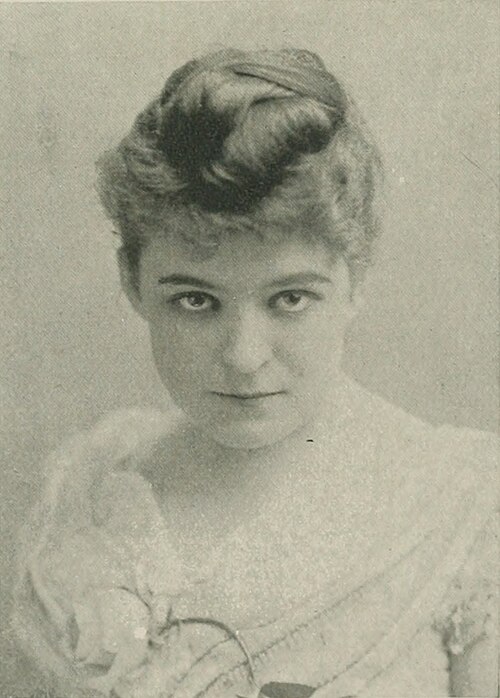 Emma Viola Sheridan Fry (October 1, 1864 - December 11, 1936), who also used the pen names "Polly" and "E. V. Sheridan," was born on October 1, 1864, in
Painesville, Ohio, and died on December 11, 1936, in Westwood, New Jersey. She was a prominent American actress, playwright, teacher, and suffragist.
Emma Viola Sheridan Fry (October 1, 1864 - December 11, 1936), who also used the pen names "Polly" and "E. V. Sheridan," was born on October 1, 1864, in
Painesville, Ohio, and died on December 11, 1936, in Westwood, New Jersey. She was a prominent American actress, playwright, teacher, and suffragist.
Her mother, Emma Christina (Huther) Sheridan, was a niece of the New England clergyman Rev. Joseph W. Parker. Her father, General George Augustus
Sheridan, served with the Army of the Cumberland during the American Civil War and later achieved national renown as an orator; Fry served as his close
friend, confidant, and counselor. Raised in an intellectually engaged environment, Fry graduated from Mrs. Hay's preparatory academy in Boston and Normal
College (now Hunter College) in New York City. She pursued professional training at the New York Lyceum School of Acting and graduated from the American
Academy of Dramatic Arts in 1885.
Beginning at the lowest rung of the profession, Fry advanced rapidly over six seasons to become a leading American stage actress. In 1887, she undertook
a notable engagement with Richard Mansfield at the Lyceum Theatre in London. Upon returning to the United States, she toured major Shakespearean parts
alongside Thomas Keene and, in 1889, became the leading lady of the Boston Museum Company. Her active acting career concluded at the close of her second
season at the Boston Museum following her marriage.
Alongside acting, she maintained a prolific writing career. She contributed stories, articles, and verses to various periodicals and newspapers, most
notably writing the popular "Polly Papers" for the New York Dramatic Mirror and a "Wednesday Afternoon" theater review column for the Boston Commonwealth.
She also wrote plays; on February 23, 1892, Richard Mansfield produced her play Ten Thousand a-Year (founded on Dr. Samuel Warren's book) at the Garden
Theatre in New York. Later in life, she compiled textbooks on educational dramatics, including Educational Dramatics and student arrangements of Twelfth
Night and Macbeth.
Transitioning fully into education and direction, Fry played a foundational role in the early twentieth-century children's theater movement in New York
City. Founded by Alice Minnie Herts with Mark Twain serving as president of the board, she directed the Children's
Educational Theatre from 1904 until 1909, staging productions such as The Prince and the Pauper (adapted from Mark Twain) and Midsummer Night's Dream. In
1910, she took charge as the dramatic director of the Educational Players and taught at the American Academy of Dramatic Arts from 1909 to 1910. Her
additional staging credits included The Tempest for Smith College alumnae in 1898. She maintained professional memberships with the New England Woman's
Press Association, the Pen and Brush Club, and served as president of the Alumni Association of the Lyceum School of Acting.
In 1891, she married Alfred Brooks Fry in Deer Isle, Maine. He was a Chief Engineer in the United States Treasury service, a member of the Loyal Legion,
a hereditary member of the Order of the Cincinnati, and later commanded the New York Naval Militia. The couple had one son, Sheridan Brooks Fry, born in
1893. Fry was an Episcopalian and a committed advocate for women's suffrage. She passed away on December 11, 1936, at the age of 72 in Westwood, New
Jersey, following a battle with tuberculosis.
Beyond her conventional marriage and public career, Emma Sheridan Fry’s life intersects with early twentieth-century queer history through her
long-term, intimate domestic partnership with the celebrated, flamboyant celebrity astrologer
Evangeline Adams. While Adams navigated turn-of-the-century laws against fortune-telling and maintained an
outsized public profile, she shared her life and home in New York with Fry. Evangeline Adams's professional and well-known primary base of operations where
she conducted her astrology practice and spent much of her daily life, famously occupied multiple suites (including suites on the 10th floor) at Carnegie
Hall in Manhattan. Because of the strict societal taboos of the era, their relationship was largely closeted, with Fry frequently cast publicly as Adams's
companion or professional associate. This hidden queer dynamic gained broader historical attention because young figures like
Carroll Righter—later a renowned astrologer to the Reagan administration—found powerful validation and
inspiration in the independent, groundbreaking lives of professional women like Adams and her enduring partner, Emma Sheridan Fry, while coming to terms
with his own homosexuality.
References:
- Willard, Frances Elizabeth, and Mary Ashton Rice Livermore, eds. (1893). "Emma V. Sheridan Fry." In A Woman of the Century: Fourteen Hundred-Seventy Biographical Sketches Accompanied by Portraits of Leading American Women in All Walks of Life. Buffalo: Charles Wells Moulton, p. 305. (Available online via [Wikisource](https://en.wikisource.org/wiki/Woman_of_the_Century/Emma_V._Sheridan_Fry)).
- Leonard, John W., ed. (1914). "Fry, Emma Sheridan". In Woman's Who's Who of America: A Biographical Dictionary of Contemporary Women of the United States and Canada, 1914–1915. New York: American Commonwealth Company, p. 309.
- New England Woman's Press Association (1895). The New England Woman's Press Association: History, Constitution, By-Laws, Members, and Work. Boston: The Association, p. 12.
- New York Red Book (1909). "Alfred Brooks Fry." Biographical entry detailing her husband's career and family background.
- "Fry – Sheridan." The New York Times, July 31, 1890. (Announcement/archive regarding early personal history).
- "Thirty-Five Actors Resign." The New York Sun, February 11, 1909, p. 7. (Documenting the operational shifts at the Children's Educational Theatre).
- "Deaths in Jersey: Mrs. Emma Sheridan Fry." The Courier-News, December 11, 1936, p. 15. (Obituary notice covering her passing in Westwood, New Jersey).
- The Asbury Park Press. December 11, 1936, p. 2. (Obituary context noting her retirement and her husband's naval militia command).
- Fisher, James, and Felicia Hardison Londré (2017). Historical Dictionary of American Theater: Modernism. Rowman & Littlefield Publishers, p. 602. ISBN: 978-1-5381-0786-7.
- García-Romero, Anne (2016). The Fornes Frame: Contemporary Latina Playwrights and the Legacy of Maria Irene Fornes. University of Arizona Press, pp. 33, 45–46, 192, 230. ISBN: 978-0-8165-3144-8.
- Ohles, Frederik, Shirley M. Ohles, and John G. Ramsay (1997). Biographical Dictionary of Modern American Educators. Greenwood Publishing Group, pp. 119–120. ISBN: 978-0-313-29133-3.
- Tukesbury, Beatrice L. (December 1964). "Emma Sheridan Fry and Educational Dramatics." Educational Theatre Journal, vol. 16, no. 4, pp. 341–348.
- Lybarger, Jeremy (2022). "Ronald Reagan’s Black Magic Man." Guernica Magazine. An essay examining Carroll Righter, Evangeline Adams, and Adams's clandestine life and domestic partnership with Emma Sheridan Fry.
Support this project
This website is a passion project researched, developed, and funded entirely by me. If you find the content valuable and would like to help support the ongoing research and hosting costs, any contribution is deeply appreciated.
Thank you for keeping this independent resource alive!
My books on Amazon: Elisa Rolle's books
BACK TO HOME PAGE